- Solar advice hub
- Costs
- How much do solar panels save you on your energy bills?
How much do solar panels save you on your energy bills?
Here's why solar panels save you money, how much they can cut your energy bills by, and what you can do to maximise your returns.


Why you can trust our content
We know that the solar industry is full of misinformation, but we only use reliable sources, including:
- Our experienced solar experts, installers and system designers
- Our own database of solar & battery system designs
- Authoritative bodies like MCS and the UK government



Calculate savings
What kind of home do you live in?


Calculate savings
What kind of home do you live in?
At a glance
You’ve probably heard that solar panels can cut your energy bills, likely accompanied by a variety of different percentages and claims, from sensible to outlandish.
It’s true that solar panels can replace some of the electricity you usually buy from the grid, and enable you to benefit even further by selling excess electricity – but it’s complicated.
In this guide, we’ll clear up all the confusion around why solar panels save you money, how much they can cut your energy bills by, and what you can do to maximise your returns.
If you’re wondering how much you could save with a solar & battery system, enter a few details below and we’ll provide a quick estimate.
Find out how much you can save
What kind of home do you live in?
Energy bill savings from solar panels in the UK
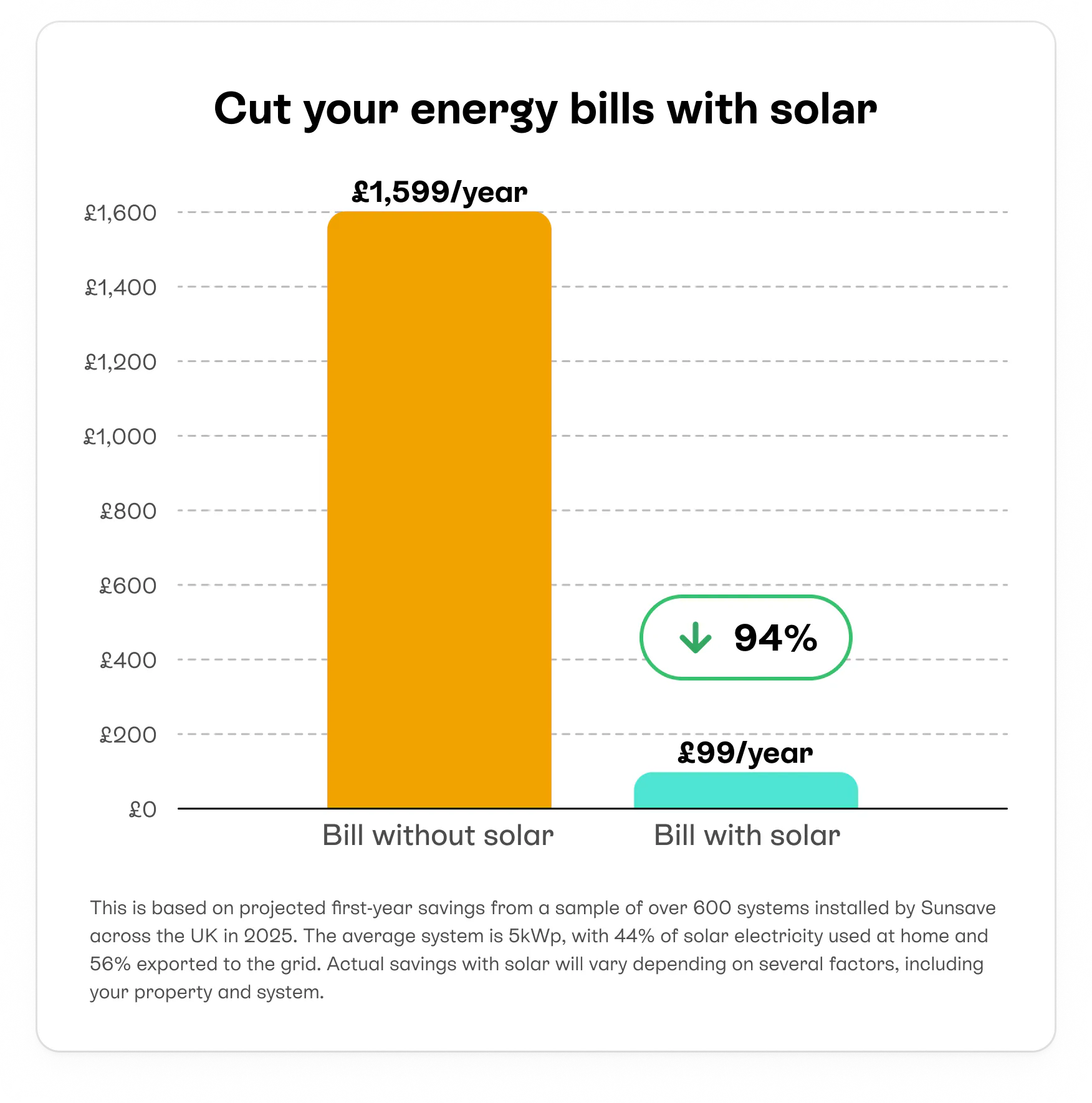
On average, you could save 94% on your electricity bills with a solar & battery system.
This is based on projected first-year savings from a sample of over 600 systems installed by Sunsave across the UK in 2025. The average system is 5kWp, with 44% of solar electricity used at home and 56% exported to the grid.
Actual savings with solar will vary depending on several factors, including your property and system.
This can mean hundreds of pounds more in your pocket every year, with many households in our sample saving more than £1,000 annually.
The UK may often endure cold, cloudy weather, but this doesn’t stop solar panels from generating plenty of electricity, since they don’t require direct sunlight – just daylight.
Since these systems are so productive, you should consider whether it’d be worth getting a heat pump or electric car and powering them with your own solar-generated electricity.
How do solar panels save you money on your energy bills?
There are two main ways in which solar panels lower your energy bills.
Firstly, they replace a substantial amount of the electricity you’d otherwise need to get from your supplier.
They also enable you to produce and sell excess electricity to the grid.
Let’s go through those factors in more detail – and make sure you read our guide to the average monthly electricity bill with solar panels.
1. Reduced electricity imports
Solar panels produce electricity throughout the year, allowing you to power your home for a large portion of each day.
This use of solar-generated electricity, known as ‘self-consumption’, lowers your bills by cutting down the amount of electricity you need to buy from the grid.
A UK household with a solar & battery system will use 54% of its solar-generated electricity, on average, and export the remaining 46%. These figures are based on the same sample of over 150 systems installed by Sunsave across England and Wales.
Solar panels produce far more electricity in the summer than they do in the winter, due to the longer days, increased amount of daylight, general lack of clouds, and the fact that the sun is higher in the sky.
This means that unless you get an incredibly large, expensive system, going solar won’t completely free you from the grid – but the electricity you’ll generate, use, and export in summers (more on that in the next section) more than makes up for the winters.
Modern monocrystalline solar panels come with top-tier power and efficiency ratings that allow you to make the most of your roof space – and with a 30-40 year lifespan, they’re usually a fantastic investment.

2. Export income
You can also sell your excess solar-generated electricity to the grid, via a solar export tariff.
This is possible thanks to the Smart Export Guarantee (SEG), which started in January 2020 as a direct replacement for the Feed-in Tariff. This government scheme compels large energy companies to pay households for all the electricity they export to the grid.
Though initially hesitant, suppliers now have multiple tariffs that go beyond their original SEG offerings, with competitive rates that pay solar homes handsomely for their electricity.
A UK household with a solar & battery system will export 46% of its solar-generated electricity, on average. This figure is based on the same sample of over 150 systems installed by Sunsave across England and Wales.
Export income is one of the biggest financial benefits of going solar, as it can earn you hundreds of pounds per year.
We’ve created an exhaustive, regularly updated guide to the best export tariffs on the market, and the best import tariffs to combine them with.
And there’s more good news: the average export tariff is increasing.
Average export tariff rates, 2020-24
Solar panel savings vs initial cost
The standard way of thinking about solar panels is as a long-term investment – you pay a high upfront cost in return for decades-long savings.
These savings will eventually outweigh the initial price of your system, which is where your investment pays off. This moment is known as the break-even point.
So if you’re looking at a system that massively reduces your energy bills, that’s great – but if it also comes with a high upfront cost, your payback period may last longer than you’d like.
This is a very real concern, considering the upfront cost of a solar & battery system is around £10,000 for the average home.
A UK household will break even on a solar & battery system in 8.1 years, on average. This figure is based on the same sample of over 150 systems installed by Sunsave across England and Wales.
Modern solar panels generally last 30-40 years, so you should be left with plenty of time to rack up your savings after breaking even.
The average system size from this data sample was 6.1 kilowatt-peak (kWp), and they all included battery storage.
Don’t fancy waiting years to break even?
If you’d like to go solar but you’re put off by the high upfront cost, you should consider Sunsave Plus.
This is the UK’s first solar subscription, and it means you can switch to solar with no upfront cost. Instead, you’ll pay a fixed monthly fee for 20 years - and that fee does indeed stay absolutely fixed for the full term.
In many cases, it’s possible for your monthly savings to exceed your monthly payments to Sunsave, meaning you can make an immediate net gain, and you won’t be waiting years to break even.
To sign up for Sunsave Plus, just answer a few quick questions below and we’ll get back to you with a savings estimate.
Find out how much you can save
What kind of home do you live in?
How rising energy costs increase savings over time
The bulk of your solar savings is based on how much you've avoided spending by importing less electricity from the grid.
This figure is the key to working out when you’ll break even, but if the price of electricity increases, your solar savings will too – and your break-even point will arrive sooner.
Historical trends suggest that a long-term increase is likely: between 2000 and 2020, the cost of electricity went up by 5.5% per year, on average.
This pattern is expected to continue into the future, with the UK’s demand for electricity increasing rapidly, our liquefied natural gas (LNG) imports falling, and ageing gas and nuclear facilities deteriorating and closing as the country moves towards net zero.
For more detail, read our in-depth guide to the future of energy prices.
Factors that impact energy bill savings from solar
The energy bill savings you make by going solar will depend on a variety of factors.
Here’s the lowdown on the most important ones.
1. The size of your system
The larger your solar panel system, the more electricity it’ll produce.
This will have two benefits. Firstly, you’ll be able to reduce how much electricity you buy from the grid, which’ll cut your energy bills.
And secondly, you’ll be able to export more electricity to the grid during the summer months, when most systems generate more electricity than a household can use.
This boost in your export income can significantly shorten your break-even period.
2. Whether you have battery storage
Getting a solar battery can substantially improve your savings.
Without one, you have to use solar-generated electricity the moment it’s produced, otherwise your system will export it to the grid.
A battery allows you to store electricity for later use, for instance during the evenings or – if you’re on a tariff with peak and off-peak rates – during times when importing electricity from the grid is more expensive.
If you don’t get a battery, your solar panels will still save you money on your energy bills, but not nearly as much.
At Sunsave, we always recommend a battery to our customers. To learn more, have a look at our comprehensive guide to solar batteries.
3. Your export tariff
It’s important to get paid as much as you can for the electricity you export to the grid, especially since small increases in your tariff can make a big difference.
For example, if you send 2,000kWh to the grid over the course of a year for 12p per kWh, you’ll end up with £240 – whereas a 15p per kWh export tariff would net you £300.
Over the course of your system’s lifespan, finding the best tariff for your household is a great way to significantly grow your savings.
This often means having to switch energy suppliers every year or two, which is usually an easy process with few drawbacks, if any.
Some suppliers offer extremely generous tariffs but require you to choose them as your installer, which can be pretty limiting, particularly if their services are expensive and/or sub-par.
This kind of tariff also excludes anyone who has already had a solar & battery system installed.
4. How much electricity you use
In most cases, raising your self-consumption will enhance your solar savings.
Since export tariffs usually pay less than the cost of importing electricity from the grid, it’s generally better to use more of your own solar-generated electricity, instead of selling it.
After all, every kWh of solar-generated electricity you use is a kWh you don’t have to pay the grid for.
Exceptions to the rule
Export tariffs have become more complex and increasingly entangled with import tariffs, so there are now a couple of major exceptions to this rule, which we’ll explain below.
First exception
Some smart import and export tariffs like Intelligent Octopus Flux negate this rule by offering identical import and export rates.
This means that in most situations, you won’t benefit financially from consuming more and exporting less of your solar-generated electricity.
We usually recommend Intelligent Octopus Flux to homes with a system that produces significantly more electricity than they use, as its high peak export rate provides them with good value.
Second exception
The creation of electric vehicle tariffs that are open to households without an EV have revolutionised the residential export market.
If you’re on one of these import tariffs, like Intelligent Octopus Go or British Gas EV Power, you can charge your battery every night for a vastly reduced rate.
You can combine this with an above-average export tariff, likely around 15p per kWh, which won’t exceed the grid’s price for electricity.
In this scenario, it makes the most financial sense to fill up your battery overnight on the off-peak rate, power your home with your battery during the day and evening, and export all the electricity your solar panels generate.
If your household’s electricity consumption increases at any point, you should ideally cover this extra usage with the electricity you import to your battery every night.
If your battery isn’t large enough and you start to use your solar-generated electricity, you’ll be getting less value out of your setup – though this is of course still better than covering your additional usage by importing from the grid at peak times.
It’s therefore best to increase your battery’s capacity to match your home’s higher consumption levels, by getting additional modules – assuming your battery has this capability.
This is one of the reasons why it’s best to get a larger battery when you first have your system installed.
How to increase your savings from solar panels
There are a few key ways to ensure you’re maximising energy bill savings from your solar panel system.
Let’s run through the most important factors you should bear in mind over the coming decades.
1. Clean your solar panels
Solar panels produce less electricity when they get dirty, as it means slightly less daylight gets through to the silicon cells.
Fortunately, panels come with a hydrophobic coating that means the UK’s plentiful rain runs straight off them, conveniently cleaning them at the same time.
Your system will still need to be washed, but usually only every two to three years, unless you live near dusty farmland or right on the coast.
You can either do this yourself, by staying on the ground and using a non-abrasive sponge connected to a telescopic pole, or by hiring a professional.
For more information, read our guide explaining how to clean your solar panels.
2. Stay on top of maintenance
Some technical experts in the industry estimate that a solar & battery system requires three call-outs across 20 years: one for the panels, one for the battery, and one for the inverter.
A battery usually lasts around 10-12 years before it needs replacing - after this point, you'll no longer be getting the best out of your system. Meanwhile, 34% of inverters fail by their 15th year.
Every Sunsave Plus system is protected by the Sunsave Guarantee, which includes 24/7 monitoring and maintenance, free replacement parts (including a battery and inverter), and downtime cover. Your system will also be insured by Aviva against damage, fire, and theft.
For more information, check out our guide to solar panel maintenance.
3. Increase your electricity consumption
In the majority of cases, increasing the amount of electricity you consume will mean using even more of your solar-generated electricity, instead of exporting it to the grid.
If you get a heat pump and an electric vehicle with a charger, for example, you can partly power them with electricity from your solar panels, which can drastically lower their running costs.
Provided your solar panels generate more electricity than you use at home – which is usually the case if it’s been sized correctly – you’ll have room to ‘grow’ into your system.
This means that increasing your electricity usage levels will lead to you raising your self-consumption rate, so your panels will supply a higher percentage of your electricity.
The amount you export to the grid will drop as a result, but it’s usually worth it, since most export tariffs don’t pay you more than the price of grid electricity.
However, if you’re on a smart import and export tariff like Intelligent Octopus Flux, which offers matching import and export rates, increasing your self-consumption may not be your best option.
At Sunsave, we always recommend an export tariff and import tariff that will maximise the financial value of your installation, together with a system that you can ‘grow’ into as the UK’s electricity demand increases.
To clarify, though: if you want to increase the amount of money you make from your solar panels, rather than your percentage saving, you should simply use less electricity.
This way, you’ll pay less for grid electricity, and sell more of your solar-generated electricity.
4. Keep an eye on new export tariffs
It pays to stay up to date with the latest export tariffs.
There’s a wide range of ever-changing tariffs available from more than a dozen suppliers, with new additions presenting you with financial opportunities every couple of months.
As our guide to the SEG explains, between 2020 and 2024, the number of available tariffs doubled from 21 to 42.
Many of them only require you to switch suppliers to qualify, which is usually a quick, painless process.
It’s also worth keeping an eye on new import tariffs, especially innovative offerings like electric vehicle tariffs that are open to households that don’t have an EV.
With all of this in mind, it can be a constant struggle to stay on top of the latest tariffs so you can choose the right one for your home. Thankfully, our guide to the best SEG rates does this work, so you don’t have to.
How can you trust savings estimates from solar installers?
When you’re exploring your solar options with different installers, they should put together proposals for you which forecast your system’s electricity generation and how much this will save you on your energy bills.
They’ll also factor in the angle and direction of your solar panels, how much shading there is on your roof, and which import and export tariffs you’ll be on.
To get accurate proposals that you can trust, you should look for installers that have had their calculations approved by the Energy Performance Validation Scheme (EPVS), a national certification standard that scrutinises energy-saving estimates.
Sunsave’s calculations are all validated by EPVS, meaning you can expect an expert-approved, top-quality proposal from us.
If you’re wondering how much you could save with a solar & battery system, enter a few details below and we’ll generate a quick estimate.
Find out how much you can save
What kind of home do you live in?
Solar panel savings: FAQs






 Charlie Clissitt
 Josh Jackman
 Josh Jackman
Written byJosh Jackman
Josh has written about the rapid rise of home solar for the past seven years. His data-driven work has been featured in United Nations and World Health Organisation documents, as well as publications including The Eco Experts, Financial Times, The Independent, The Telegraph, The Times, and The Sun. Josh has also been interviewed as a renewables expert on BBC One’s Rip-Off Britain, ITV1’s Tonight show, and BBC Radio 4 and 5.