- Solar advice hub
- Installation
- Can you put solar panels on a garage roof?
Can you put solar panels on a garage roof?
You may well be able to put solar panels on your garage roof. Here's how to figure out whether it's suitable, and how the installation would work.


Why you can trust our content
We know that the solar industry is full of misinformation, but we only use reliable sources, including:
- Our experienced solar experts, installers and system designers
- Our own database of solar & battery system designs
- Authoritative bodies like MCS and the UK government


Calculate savings
What kind of home do you live in?


Calculate savings
What kind of home do you live in?
Solar panels on garage roofs: at a glance
When you’re switching to solar, it’s always best to get as many panels as possible – and with a garage roof, you can boost your savings without adding much to your costs.
Though garage roofs can sometimes increase your installation’s complexity, a good installer should be able to analyse your situation and present numerous tried and tested solutions.
More than 1.5 million households now have solar panels, and many of these installations will have involved putting a few extra panels on a garage roof.
If you’re wondering how much you could save with a solar & battery system, enter a few details below and we’ll provide an estimate.
Find out how much you can save
What kind of home do you live in?
Is your garage roof suitable for solar panels?
If your garage roof is pitched and receives enough daylight, it may well be suitable for solar panels.
A good solar company will treat a garage roof in the same way as any other roof: by taking steps that assess whether it’s structurally sound and ready for a solar installation.
This will include taking a look at your loft space, so they can assess the rafters.
However, if your garage has a flat roof, this will present issues.
The standard way to fit rooftop solar panels is to drill into the rafters, attach mounting brackets and rails, and secure the panels to them.
This isn’t possible on a flat roof, where rainwater sticks around instead of flowing off at an angle, and could therefore leak through any holes.
There is another method, but it involves using 80kg ballasts to hold down solar panels that are around 20kg each.
This makes the system roughly five times heavier, and means a 10-panel system ends up putting a tonne of weight on your roof. Many flat roofs aren’t strong enough to handle that.
That’s why we don’t recommend going solar on any flat roof, whether it’s a garage or not.
For more information, check out our guide to solar panels on flat roofs.
Is a garage roof big enough for solar panels?
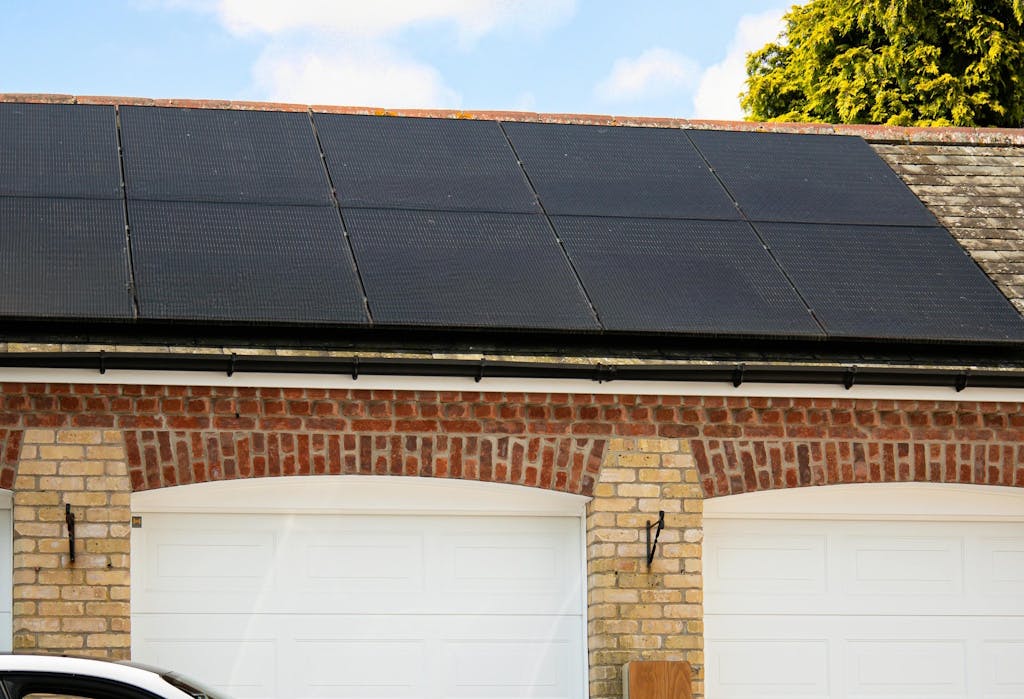
Garage roofs are normally big enough to hold some solar panels, which is why households often use them to increase their total generating capacity.
However, if it’s the only roof you have that can hold solar panels, it may be too small.
This is because in the unlikely scenario that panels can’t go on your home’s roof, it’s only worth installing them on your garage roof if you can fit an entire system up there.
At a minimum, that tends to mean at least six 450-watt (W) panels, as any fewer won’t generally save you enough money on your energy bills to make it worth the upfront cost of solar.
And even large garage roofs in the UK don’t always have the roughly 20m² of space that it takes to fit six panels to industry standards.
If you’re wondering how much you could save with a solar & battery system, enter a few details below and we’ll provide an estimate.
Find out how much you can save
What kind of home do you live in?
How are solar panels installed on a garage?
Solar panels are installed on a garage in much the same way as they are on a house.
There can be additional complications though, depending on whether the garage is attached to your home or not. Here are the approaches your installer should take in both cases.
Solar panels on a detached garage
If there’s a gap between your home and garage, your solar installer must ensure the cables between them stay out of your way.
After all, you don’t want to drive or trip over the cables connecting your panels with your solar fuse board. You could get injured, and potentially stop your system from working.
There are two main options: put the cables in a trench underground, or feed them overhead.
Trenching is usually more time-consuming and expensive, but you may prefer it from an aesthetic point of view, as it means you won’t have visible cables between your garage and home.
You’ll need to make sure it’s done before your installer arrives, though. You can do it yourself and save money, or you can contact a local groundworks company to carry it out for you.
If you and your installer agree on the overhead route, they’ll use a catenary wire that suspends and protects the cables from the elements.
A good installer will ensure that this wire sits well above any vehicles that could potentially drive underneath it, and generally follows the British Standard Wiring Regulations (also known as BS7671).
Your system’s design will determine which cables are included in this underground or overhead setup.
If you’re getting panels on your detached garage, with a battery and inverter located at your main property, it’ll just be a DC cable travelling between the two buildings.
But if your garage is housing the battery and inverter as well as the panels, your installer will need to feed an AC cable and communication cable from the garage to your home.
Solar panels on an attached garage
Putting solar panels on an attached garage is a much simpler, less expensive process.
Your installer won’t need a trench or a catenary wire, so they’ll be able to focus on fitting as many panels on your garage as possible, since maximising your roof space pays off.
Additional panels don't add much to what you pay, as the majority of the overall cost comes from labour and scaffolding. You’ll further cut the amount of electricity you buy from the grid, and have even more electricity to sell through an export tariff.
In short, it’s almost always worth getting a larger solar panel system, if you can.
The only possible barrier to using every square metre available to you is that garage roofs are often significantly lower than a house’s roof. This can lead to significant shading on an attached garage.
Your installer should take this into account, and refrain from putting panels in a position where they won’t receive enough daylight.
They can combat a decent amount of shading with optimisers or microinverters, but there’s a limit to what anyone can do.
What if your garage roof isn’t suitable for solar?
If your garage roof is flat, if it can’t hold a solar panel system, or if it’s otherwise unsuitable, there are other ways to switch to solar.
That’s why the most important step to going solar is picking the right installer, as a top-tier company will be able to advise you on the best options for your home.
Just stick with your main household roof
The most common alternative is to only use your main roof.
This may mean you’ll have to get a smaller system – which unfortunately means lower savings – but as long as your installer can fit at least six or so panels, it’s still a worthwhile project.
You’ll cut your energy bills, produce excess electricity that you can sell to the grid through one of the best export tariffs, and potentially increase the value of your home.
Get ground-mounted solar panels
If you don’t have sufficient roof space, but you own a decent amount of land – or even just a particularly large garden – ground-mounted solar panels may be the answer.
However, they are significantly more expensive than rooftop installations.
A 10kWp solar array costs around £27,000 if you install it on the ground , or £18,460 on your roof.
This is the main reason you don’t see many domestic properties with a ground-mounted system. Solar panel costs are already high, so an even more expensive method is out of reach for the great majority of people.
You’ll also likely need to apply for planning permission before you can move ahead.
Ground-mounted systems need permission if they’re set to take up more than nine square metres, be higher than four metres, wider than three metres, or deeper than three metres at any point, or if they’ll be within five metres of a property boundary.
And if you ever want to add more solar panels, you’ll have to apply for permission all over again.
For more information, read our guide to ground-mounted solar panels.
Summary
Using a garage roof to get yourself a larger solar panel system can increase your savings without costing you much more.
There can be complications, and your garage may not end up being suitable, but it’s always worth checking.
A good installer like Sunsave will make an assessment and put together the best design for your home, ensuring that you get the most out of your available, usable roof space.
If you’re wondering how much you could save with a solar & battery system, enter a few details below and we’ll provide an estimate.
Find out how much you can save
What kind of home do you live in?
Solar panels on a garage roof: FAQs



Related articles

 Josh Jackman
 Josh Jackman
 Josh Jackman
 Josh Jackman
Written byJosh Jackman
Josh has written about the rapid rise of home solar for the past seven years. His data-driven work has been featured in United Nations and World Health Organisation documents, as well as publications including The Eco Experts, Financial Times, The Independent, The Telegraph, The Times, and The Sun. Josh has also been interviewed as a renewables expert on BBC One’s Rip-Off Britain, ITV1’s Tonight show, and BBC Radio 4 and 5.