- Solar advice hub
- Solar-technology
- The best new solar panel technology in 2026
The best new solar panel technology in 2026
Here are our nine favourite advances in solar technology, including a quantum secret and a translucent solar film.


Why you can trust our content
We know that the solar industry is full of misinformation, but we only use reliable sources, including:
- Our experienced solar experts, installers and system designers
- Our own database of solar & battery system designs
- Authoritative bodies like MCS and the UK government



Calculate savings
What kind of home do you live in?


Calculate savings
What kind of home do you live in?
At a glance
The solar industry is constantly innovating to make its products more effective, long-lasting, and versatile, with the help of researchers and scientists all over the world.
2025 saw a number of exciting developments that could give more people the ability to generate their own electricity in better ways.
In this guide, we’ll run through our nine favourite advances in solar technology that happened last year, which we’ll be keeping an eye on as we move through 2026.
At Sunsave, we install top-tier black monocrystalline solar panels. If you’re wondering how much you could save with a solar & battery system, enter a few details below and we’ll provide an estimate.
Find out how much you can save
What kind of home do you live in?
What’s the latest solar panel technology in 2026?
Scientists across the world have made stunning recent advances in solar technology.
Solar electricity already forms a huge part of the world’s energy supply, but with these improvements, installations could be more productive, resilient, and versatile.
Researchers found potential solutions to deficits in transparent, thin-film, and perovskite solar panels, and ways to tackle – and utilise – the effects of heat on solar installations.
None of this progress will stop monocrystalline solar panels from continuing to dominate the rooftop solar landscape, but it may create a cheaper, more effective manufacturing process.
We’ll be charting the most exciting technological developments in chronological order.

9. Kesterite solar cells
January 2025
Kesterite was named in 1956, after the Kester deposit in eastern Russia’s Ynnakh Mountain where it was found.
The synthetic form takes copper, zinc, and tin, and combines this mixture with sulphur, selenium, or a mix of the two. This results in CZTS or CZTSSe.
All of these elements are abundant, cheap, and non-toxic, which is the gold standard for manufacturing, and is rarely found elsewhere in solar production.
It’s been the subject of thin-film solar research for many years, and after a decade of stagnation, scientists finally made an efficiency breakthrough in 2022. Since then, progress has been rapid.
And in January 2025, scientists at the University of New South Wales hit a record-high efficiency of 13.2% for a kesterite solar cell.
This is far below the standard efficiency for a thin-film solar panel, which is around 18.6%, but it still represents a massive step forward.
8. Photonic spheres
July 2025
In July 2025, New York-based company Wavja announced that it’d created the third edition of its Photon Energy System, and made some big claims.
The tech firm said its metallic balls can generate electricity from both natural and artificial light – including LEDs – and store it, too.
In the same video announcement, co-founder and immigration lawyer Shereen Chen declared that the balls were 200 times more efficient than solar panels.
This would be an incredible development, but should be taken with a large heaping of salt – after all, the company hasn’t explained anything about the inner workings of its technology.
It has, though, suggested that the balls could one day power everything from flying cars to unmanned taxis and shipping container drones.
7. Solar power window coatings
July 2025
Scientists at Nanjing University in eastern China have potentially found a solution for the issues that stop us from turning every window into a source of solar electricity.
The idea of transparent solar panels is alluring, but in practice, these products are usually semi-transparent, with the fully see-through versions only being about 1% efficient.
This compares poorly with top-tier rooftop panels, which are roughly 20-25% efficient – but that may soon change.
The team at Nanjing University has created a translucent film that can act as a solar concentrator on windows, directing natural light to the solar cells built into the frame.
Crucially, this film also lets light into the room behind it, meaning you theoretically wouldn’t be able to tell that your window was producing solar energy.
The film is made from layers of cholesteric liquid crystals, which have already been used to develop smart paints and textiles that detect and display problems – for instance, a structural issue with a wall.
It can be used to cover pre-existing windows, which would be a much easier process than replacing them.
6. Hotter panels, better storage
August 2025
Solar electricity production spikes in summer, when the sun is high in the sky, the days are longer, and clouds are less common – but any temperatures above 25°C can cause panels to lose some efficiency.
This downside could be on its way out though, thanks to photoelectrochemical redox flow cells.
This technology’s ability to generate and store electricity actually improves as it gets hotter, up to an optimal temperature of 45°C, according to researchers at Heriot-Watt University and Loughborough University.
One of the study’s authors, Dr Dowon Bae, said that “instead of fighting against the heat, engineers can now use it to their advantage, creating more efficient solar energy storage solutions.”
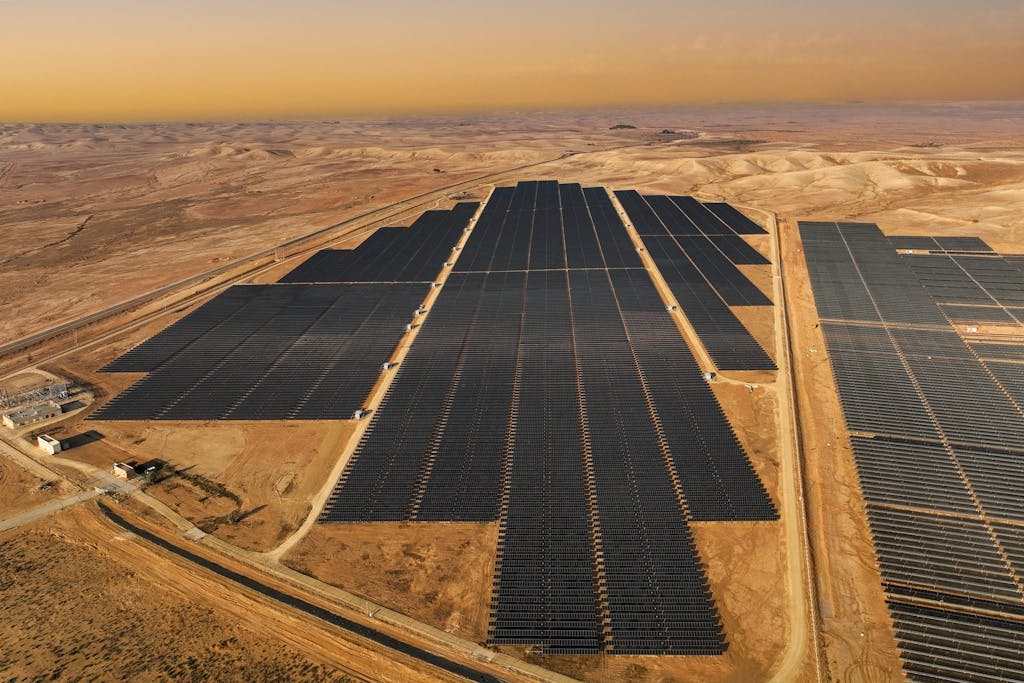
The world’s largest solar farms tend to operate in hot regions like the Middle East, North Africa, and South Asia. If these cells can be used in similar locations, global solar production could rise sharply.
5. Solar panel cooling
August 2025
If it takes a while for photoelectrochemical redox flow cells to become widespread, there may be another way for solar buildings to prevent efficiency losses in hot conditions.
Scientists at the United Arab Emirates’ University of Sharjah have come up with an elegant solution: blow your air conditioning system’s waste air at the back of your solar panels.
This technique cools solar panels without blocking any daylight from hitting them, and without buying any new equipment. You just have to redirect your exhaust fan.
The researchers have secured a US patent, which shows how serious they are about this concept.
One of the researchers, Professor Chaouki Ghenai, said the process “reduces the temperature of the solar cells, recovers up to 10% more solar power production, and extends the life of the panels.”
This makes sense, since consistently hot temperatures can cause long-term damage to solar installations.


4. Copper instead of silver
September 2025
The cost of silver has skyrocketed in recent times, to the extent that the small amount used in solar cells now makes up 29% of its manufacturing cost – up from just 3.4% in 2023.
The scarcity of silver and popularity of solar panels mean that its price will likely stay high for a while – but researchers have found you can almost seamlessly replace it with copper.
The Dutch Organisation for Applied Scientific Research has shown that this widely available element, which is around 100 times cheaper, performs to within 1% of silver’s effectiveness.
Solar manufacturers mainly use silver to produce grid lines. This study suggests that they could put copper into existing screen-printing machines instead, with near-identical results.
3. A 100-year-old quantum secret
October 2025
Late last year, scientists discovered that contrary to a century of conventional wisdom, there’s an organic molecule that can generate electricity.
Solar panels produce electricity when daylight hits them and dislodges the electrons in their silicon atoms.
This organic semiconductor molecule, P3TTM, comes with a single, already-dislodged electron – so when it comes into contact with natural light, it can be harnessed to create an electrical charge.
By using this molecule, the researchers from Cambridge University, Pisa University, and Mons University reportedly created a solar cell that converted almost every photon of light into electricity.
This is extremely exciting, considering that solar cells have only ever reached a peak efficiency of 47.6%.
One of the study’s authors, Professor Hugo Bronstein, said: “We are not just improving old designs. We are writing a new chapter in the textbook, showing that organic materials are able to generate charges all by themselves.”
2. Ultrablack copper cobaltate nanoneedles
October 2025
University of the Basque Country scientists have found a way to make concentrated solar power (CSP) systems even more efficient.
These gigantic systems use hundreds of sun-tracking mirrors to reflect daylight onto a central tower, which takes the roughly 600°C of heat that this light produces and converts it into usable energy.
Currently, these towers use black silicon that absorbs 95% of the light shone at them – but this research has created a new, better material.
The scientists took the copper cobaltate nanoneedles developed by the University of California San Diego, and coated them in zinc oxide – making them even darker.
These ultrablack copper cobaltate nanoneedles absorb up to 99.5% of the light they receive, and they remain stable in hot, humid conditions.
1. Perovskite and secret octopus molecules
January 2026
Here’s one bonus development from the start of 2026: scientists have found a naturally occurring compound that could stop perovskite solar panels from rapidly deteriorating.
Perovskite panels have achieved efficiency ratings above 30%, putting them at the forefront of solar technology, but their 10-year lifespan is a major drawback.
When oxygen interacts with the inner workings of perovskite solar panels, it leads to their degradation and eventual destruction – and it’s hard to completely avoid.
Even when manufacturers place a tight seal around the panel’s insides, they inevitably trap some air inside.
However, this can be avoided by coating the innards with a microscopic layer of taurine, according to researchers at the Korea Institute of Science and Technology and Daegu Gyeongbuk Institute of Science and Technology.
Taurine is abundant in invertebrates like octopuses and squids – though it may be easier to get it from fish or mammals – and could hold the key to perovskite panels going mainstream.
Summary
Scientists made great strides in 2025, uncovering a multitude of ways to make solar installations cheaper, more efficient, and more resilient.
These new developments will advance important work on solar windows, perovskite panels, thin-film panels, photoelectrochemical cells, and concentrated solar power systems.
While they won’t help too much with domestic solar panel systems, this doesn’t matter. Households can already benefit from productive, long-lasting panels that generate electricity at all times of the year.
At Sunsave, we install top-tier black monocrystalline solar panels. If you’re wondering how much you could save with a solar & battery system, enter a few details below and we’ll provide an estimate.
Find out how much you can save
What kind of home do you live in?
New solar panel technology: FAQs





Related articles
 Josh Jackman
 Josh Jackman
 Josh Jackman
 Josh Jackman
Written byJosh Jackman
Josh has written about the rapid rise of home solar for the past seven years. His data-driven work has been featured in United Nations and World Health Organisation documents, as well as publications including The Eco Experts, Financial Times, The Independent, The Telegraph, The Times, and The Sun. Josh has also been interviewed as a renewables expert on BBC One’s Rip-Off Britain, ITV1’s Tonight show, and BBC Radio 4 and 5.