Where does the UK get its gas from?
Here are all the countries that the UK buys gas from – and how this is likely to change in the coming years.


Why you can trust our content
We know that the solar industry is full of misinformation, but we only use reliable sources, including:
- Our experienced solar experts, installers and system designers
- Our own database of solar & battery system designs
- Authoritative bodies like MCS and the UK government



Calculate savings
What kind of home do you live in?


Calculate savings
What kind of home do you live in?
UK gas sources: at a glance
The UK’s gas supply has fallen under the spotlight once again, as energy prices have soared since the start of the Iran conflict.
Where we get our gas from – and how much of it we use – has a direct effect on the price of domestic gas and electricity.
In this guide, we’ll run through all the different countries that sell us gas, and explain the likely future of gas imports and consumption in the UK.
All our figures are based on gas import and export data published by the UK government in February 2026.
If you'd like to be somewhat protected from the effects that geopolitical turbulence regularly has on the price of gas, going solar is a great way to become more energy independent.
To see the savings you could get from a solar & battery system, just answer a few quick questions below, and we’ll provide an estimate.
Find out how much you can save
What kind of home do you live in?
The UK’s gas sources: explained
The UK uses a tremendous amount of gas, most of which we import.
Companies on these shores have produced gas for decades, but they don’t churn out enough to meet demand – and they export 40% of their supply to other countries.
This leaves the UK needing to import 67.9% of its gas supply, according to calculations we made using the latest government data – most of which comes from Norway and the US.
Below, you can see all of the UK’s gas sources, and how much of our supply they provide.
Source | Quantity of gas (TWh, 2025) | % of total (2025) |
|---|---|---|
Norway | 322.1 | 47.1 |
Domestic (North Sea & biomethane) | 207.2 | 30.3 |
US | 104.4 | 15.3 |
Algeria | 8.3 | 1.2 |
Qatar | 8.2 | 1.2 |
Trinidad & Tobago | 4.2 | 0.6 |
Belgium | 4.1 | 0.6 |
Angola | 2.9 | 0.4 |
Nigeria | 2.6 | 0.4 |
Peru | 2.1 | 0.3 |
Netherlands | 2.0 | 0.3 |
Equatorial Guinea | 1.1 | 0.2 |
Brazil | 0.9 | 0.1 |
Mexico | 0.9 | 0.1 |
Map of the UK's gas sources, 2026
1. Norway
322.1TWh of gas in 2025, 47.1% of total UK consumption
Norway keeps the UK running, providing 47.1% of our gas from its state-owned reserves.
That’s 69.5% of the gas we imported in 2025, continuing a streak that’s seen the Scandinavian country supply the majority of the UK’s gas imports for 24 of the past 26 years.
It is, by far, our most important gas supplier – and fortunately, one of our most stable relationships in this field. Any rift in this alliance could be catastrophic for the UK.
Norway sent 99.4% of this gas through pipelines in 2025, with the remaining 0.6% shipped over in the form of Liquefied Natural Gas (LNG).
The nation earned a total net income of £5.1 billion in 2025 from its worldwide oil and gas exploits, which are majority-owned by its government.
2. The UK
207.2TWh of gas in 2025, 30.3% of total UK consumption
The North Sea is responsible for the vast majority of the UK's gas production.
It has provided the country with gas since 1966, and until 2004, it allowed the UK to be self-sufficient – but those days are long gone.
In 2025, sites in the area produced enough gas to supply 47.5% of the UK’s demand, according to the latest government data.
41% of that gas was exported, and we should get used to not having North Sea gas for too much longer.
The North Sea’s proven gas reserves – those with a 90% or better chance of being produced – have dwindled to 19% of what they were in 1996, according to our analysis of data from the Office for National Statistics (ONS).
There isn’t much more joy in probable reserves – which are more than 50% likely to be produced – or possible reserves, which have a 10-50% chance. Both have fallen to 10% of their 1996 levels.
The North Sea contains proven reserves of just 1,654TWh (terawatt-hours), so if we carry on extracting gas at the rate we did in 2024, we’ll run out of this supply in less than five years.
Even if all probable and possible reserves are fully plundered, we’ll still use up all our North Sea gas in less than a decade.
The latest gas licences handed out by the government will have a negligible effect on this, especially if they follow the average timeline of 28 years from licence to production.
While 97.6% of UK gas production happens at North Sea sites, the remaining 7.9TWh churned out on these shores is biomethane – roughly the same as Qatar provides.
This gas is created using anaerobic digestion, which is where organic materials naturally break down in the absence of oxygen.
3. US
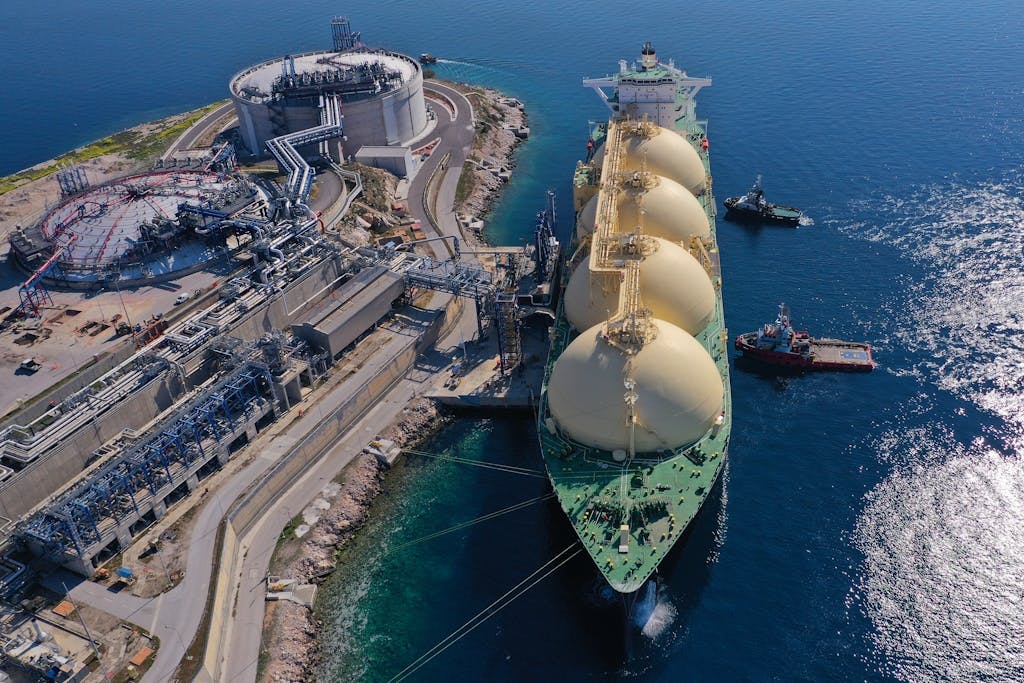
104.4TWh of gas in 2025, 15.3% of total UK consumption
In 16 of the 17 years up to 2017, the US supplied the UK with zero gas.
In the years since, we've regularly imported LNG from the US, at a gradually increasing rate – until the energy crisis hit near the end of 2021.
The next year, the proportion of gas imports we sourced from the US jumped from 7.5% to 22.4%, and it rose again to 26% in 2023.
These LNG imports were crucial in eliminating our need for Russian gas and lessening our reliance on potentially unstable nations like Qatar.
This figure fell in 2024, but increased again in 2025 – to the third-highest amount of gas we've ever imported from the US.
4. Algeria
8.3TWh of gas in 2025, 1.2% of total UK consumption
Algeria is the UK’s oldest source of gas, including the North Sea.
We’ve been importing Algerian LNG since 1964, when the north African nation opened the Arzew Gas Terminal on its northern coast.
This LNG plant was one of the first in the world, coming two years before the North Sea started producing gas.
In the recent past, the peak in LNG relations between the two countries was 2006, when Algeria supplied 8.8% of the UK’s gas imports.
From 2005 to 2010, Algeria exported 64TWh of LNG to the UK – more than it sent between 2014 and 2025.
We’ve bought considerably more LNG from Algeria since 2021, with 2025 representing a recent peak, though our imports are still nowhere near pre-2011 levels.
5. Qatar
8.2TWh of gas in 2025, 1.2% of total UK consumption
Our imports from Qatar have fallen in recent years, to the extent that it's lost its position as our third-biggest foreign supplier.
In 2011, we sourced 39.2% of our gas imports from the Middle Eastern state, but this figure has dropped over the years, and made up just 1.8% in 2024.
That’s the lowest proportion of our gas imports we’ve bought from Qatar since 2008 – when we didn't receive anything – and shows that the UK is moving away from relying on the controversial nation.
6. Trinidad and Tobago
4.2TWh of gas in 2025, 0.6% of total UK consumption
The UK reduced its LNG imports from Trinidad and Tobago by 43% in 2025, compared to 2024 – which is relatively normal.
We've always receive gas from the Caribbean nation in waves, ever since we began importing from there in 2005.
However, it is a consistent supply channel. 2025 made it 20 out of the past 21 years that the country has supplied us with gas.
Trinidad and Tobago is the largest LNG producer in South and Central America, despite being one of its smallest nations – it's around 2% the size of the UK – and is economically dependent on this revenue stream.
7. Belgium
4.1TWh of gas in 2025, 0.6% of total UK consumption
Belgium is one of three countries – along with the Netherlands and Norway – that supply us with gas through pipelines.
Gas has flowed from along the Interconnector line from Zeebrugge in Belgium to Bacton in the UK since 1998.
At various points in recent years, Belgium has provided the UK with substantial amounts of gas, but since 2022, we've bought a relatively small amount.
We did import nearly four times as much Belgian gas in 2025 as we did in 2024, though – which was the most we've received since 2021.
The country has also sold us LNG in the past, but only in 2016 and 2020.
8. Seven other countries
12.5TWh of gas in 2025, 1.8% of total UK consumption
From largest to smallest supplier, the rest of the UK’s gas comes from Angola, Nigeria, Peru, Netherlands, Equatorial Guinea, Brazil, and Mexico.
This is the first time we've imported gas from Brazil or Mexico, while Equatorial Guinea and Angola only started supplying us with LNG in 2018 and 2019, respectively.
We have long relationships with all the other countries.
Egypt and the Netherlands have supplied us with gas since 2006, while we’ve imported gas from Nigeria since 2010.
The UK started buying LNG from Peru's controversial Camisea gas fields in 2017, and massively raised its intake when the energy crisis started, but has cut its imports by 89% since 2023.
If you'd like to somewhat protect yourself from the effects that geopolitical events like the Iran conflict can have on your bills, going solar is a great way to become more energy independent.
To see the savings you could get from a solar & battery system, enter a few details below and we’ll provide an estimate.
Find out how much you can save
What kind of home do you live in?
How much gas does the UK consume?
The UK consumes 683TWh of gas per year, according to the government’s latest report.
Since 1998, our gas consumption has fallen by 33% – but most of this reduction happened in 2011, 2022, and 2023.
Unfortunately, 2012 to 2021 was a lost decade, as we used the same amount of gas at both ends of this period.
The current level puts us in the top 12 highest gas-consuming countries in the world, ahead of large nations like Egypt, Brazil, and France.
Reducing our gas usage is a crucial step towards cutting our energy bills, slashing our emissions, and becoming more energy independent.
UK gas demand, 1998-2025
Where will the UK get its gas from in the future?
The UK has consciously moved away from relying on a handful of gas exporters in the past few years – a trend we expect to intensify.
As well as opening up relationships with Brazil, Mexico, Angola, and Equatorial Guinea, the UK has also sourced LNG from Chile, France, and Spain at times in the past five years.
The UK will likely keep diversifying its supply, while continuing to rely most heavily on the deep, stable reserves in Norway, particularly as the North Sea’s reserves run out.
Thankfully, gas consumption in the UK is dropping, lessening our need for imports.
Demand fell by 38% in the UK between 2010 and 2025, and it’ll continue to decline as the country moves to fulfil its net zero obligations by replacing gas with renewable electricity.
Will the UK ever stop needing gas?
Legally, the UK must move away from using gas.
In 2019, our parliament passed a government bill into law that fixed the UK’s commitment to reach net-zero emissions by 2050.
Achieving this target will require every government from now until 2050 to move towards an energy network that’s based on renewable sources, while phasing out fossil fuels like gas.
This will lead to the electrification of everything from industry and transport to heating, with heat pumps, electric vehicles, and manufacturing machines all running on green electricity that we’ll generate with the likes of solar panels and wind turbines.
Reaching net zero doesn’t necessarily mean wiping out all sources of greenhouse gases, as this may prove impossible. The UK will offset emissions from completely unavoidable sources – but that doesn’t include gas.
Its roles in industry, the production of electricity, and heating can all be replaced. The time of gas is coming to a close.
Looking ahead
The UK gets most of its gas from Norway, the North Sea, and the US, in that order.
The North Sea’s supply is running low though, like many reserves – and as some countries run dry or move away from producing gas for environmental reasons, this will result in higher prices for everyone else.
Like all nations, the UK faces a choice: don’t address the issue and keep buying increasingly expensive gas from potentially unstable sources, or build renewable infrastructure like solar and wind farms.
Using our own green sources means reducing our reliance on imports, which will lower household energy bills and make us less vulnerable to geopolitical shifts.
If you'd like to use renewable energy instead of relying on global stability, going solar is a great way to cut your costs and guard against price spikes.
To see the savings you could get from a solar & battery system, just answer a few quick questions below, and we’ll provide an estimate.
Find out how much you can save
What kind of home do you live in?
UK gas sources: FAQs
Related articles
 Josh Jackman
 Josh Jackman
 Josh Jackman
Written byJosh Jackman
Josh has written about the rapid rise of home solar for the past seven years. His data-driven work has been featured in United Nations and World Health Organisation documents, as well as publications including The Eco Experts, Financial Times, The Independent, The Telegraph, The Times, and The Sun. Josh has also been interviewed as a renewables expert on BBC One’s Rip-Off Britain, ITV1’s Tonight show, and BBC Radio 4 and 5.