- Solar advice hub
- Costs
- What’s the average monthly electricity bill with solar panels?
What’s the average monthly electricity bill with solar panels?
Electricity prices are staying high – but switching to solar is a proven way to reduce your energy bills. Here's what you can expect.


Why you can trust our content
We know that the solar industry is full of misinformation, but we only use reliable sources, including:
- Our experienced solar experts, installers and system designers
- Our own database of solar & battery system designs
- Authoritative bodies like MCS and the UK government



Calculate savings
What kind of home do you live in?


Calculate savings
What kind of home do you live in?
At a glance
Electricity prices are high across the UK – and there’s no sign of this significantly changing any time soon.
Cornwall Insight has predicted that energy prices will stay high until the late 2030s, while Octopus Energy’s Rachel Fletcher said in October 2025 that domestic energy bills will likely rise by 20% over the next four years.
Fortunately, switching to solar is a proven way to reduce your energy bills and lessen the effect of any future price rises.
If you’re wondering how much you could save with a solar & battery system, enter a few details below and we’ll provide an estimate.
Find out how much you can save
What kind of home do you live in?
How much money do solar panels save you?
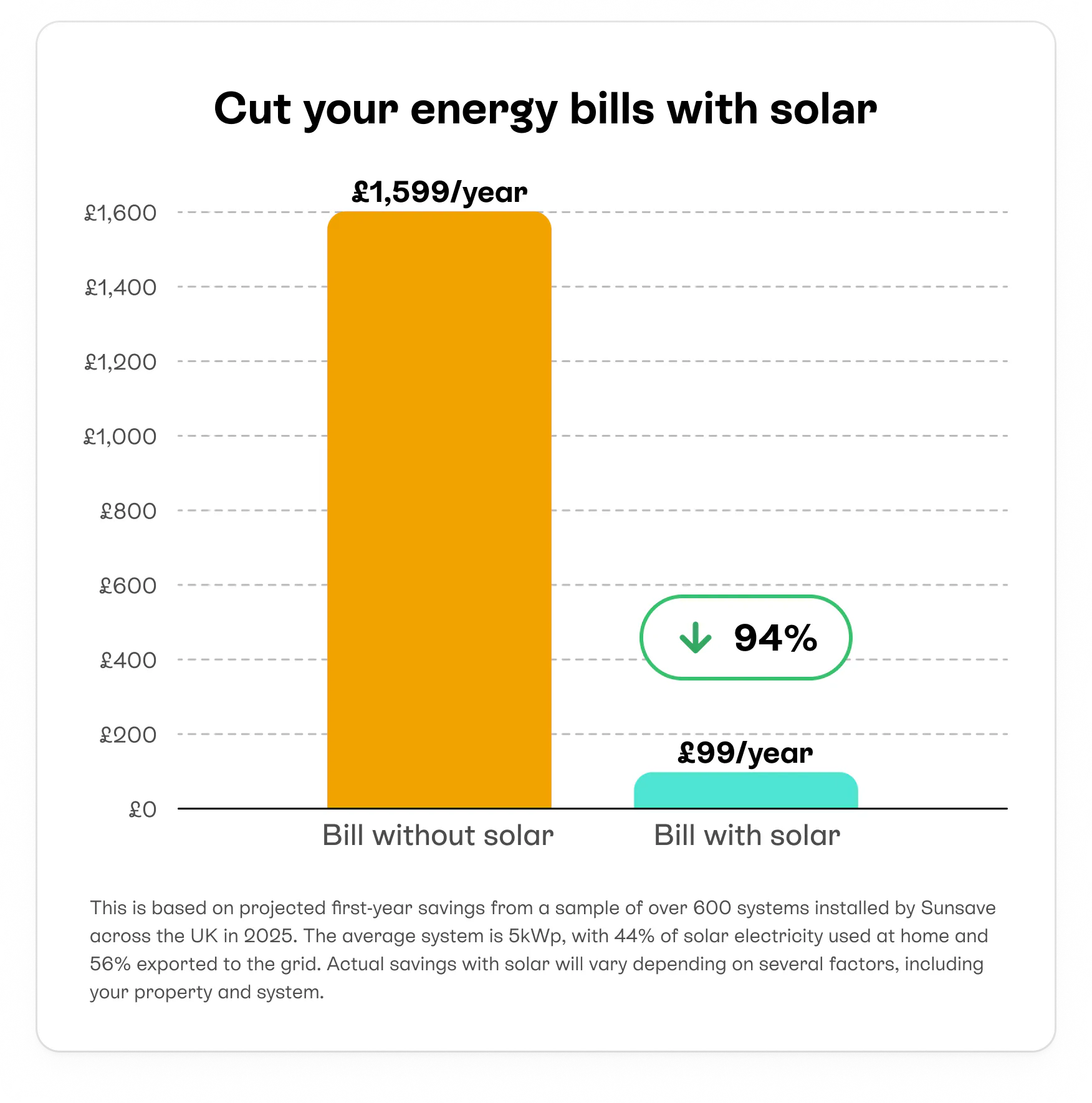
A solar & battery system can cut a UK household’s electricity bill by 94%, on average.
This is based on projected first-year savings from a sample of over 600 systems installed by Sunsave across the UK in 2025. The average system is 5kWp, with 44% of solar electricity used at home and 56% exported to the grid.
Actual savings with solar will vary depending on several factors, including your property and system.
This is just an average though, meaning your savings percentage could be even higher – particularly in the south, where you’ll find all the sunniest parts of the UK.
Solar panels only need daylight to function, rather than direct sunlight, which is why the technology can still provide such significant savings to UK households.
Let’s explore how these savings work on a monthly basis.
What’s the average monthly electricity bill in the UK?
The average monthly electricity bill in the UK is £73, as of the April 2026 price cap.
This is 62% higher than it was in 2020, when a household paid £45 per month on average.
These figures are based on Ofgem’s Typical Domestic Consumption Values, which estimate that homes use 2,700 kilowatt-hours (kWh) of electricity per year – unlike the government, which puts this figure at 3,400kWh.
If we went with the 3,400kWh figure, that’d mean the average bill was £87 per month today, and £55 per month in 2020.
Your actual monthly electricity bill will change with the seasons, though: in winter, usage is 27% higher than it is in summer, meaning your costs will be higher too.

How do solar panels affect your monthly bill?
The average monthly electricity bill is just £5.24 with a solar & battery system, based on a 94% saving and an annual consumption of 3,400kWh.
It's also based on a home that was on the April 2026 energy price cap before switching to solar.
This is just an average, though. Some months will be more expensive than others – particularly in winter – while your bills in summer should be much lower.
Annual electricity usage (kWh) | Average monthly electricity bill (without solar) | Average monthly electricity bill (with solar)* | Monthly saving |
|---|---|---|---|
2,700 | £73 | £4 | £69 |
3,400 | £87 | £5 | £82 |
5,000 | £120 | £7 | £113 |
This dramatic level of savings is simple to achieve, as long as you get a large enough system and sign up to the best import and export tariffs for your home.
If you’re wondering how much you could save with a solar & battery system, enter a few details below and we’ll provide an estimate.
Find out how much you can save
What kind of home do you live in?
Monthly electricity bill with solar panels in the summer
In summer, your solar panels will usually produce a lot more energy than you need, thanks to the many long, sunny days.
Summers are responsible for 38% of solar output, according to Sunsave data – much more than any other season.
Thankfully, you can sell the excess via an export tariff. Check out our guide to the best export tariffs to see which combination of export and import rates would suit your home.
You’ll usually receive your export payments directly from the provider, rather than as a deduction on your energy bill – but the effect is the same.
During summer, you’ll likely export plenty of electricity and barely buy any from the grid – both because you’re using less, and because your solar panels are generating so much.
You’ll also export electricity in other seasons, but your total should be significantly higher in summer.
Monthly electricity bill with solar panels in the winter
Solar panels don’t generate as much electricity in winter, as the sun rises and sets earlier, takes up a lower position in the sky, and is often obscured by clouds.
The average system does produce 11% of its annual output in winter, which will lower your costs somewhat.
Your electricity bill will still be relatively high though, as you’ll mostly rely on the grid for your electricity, and won’t export much.
However, your system’s productivity in summer should significantly outweigh its lower output in winter, resulting in massive savings across the year.
Do you still save without a battery?
Solar panels will still save you money on your energy bills without a battery, but your savings with a battery should be substantially higher.
We designed two example systems for an average home in Bristol – one with a battery, and one without – and the difference was stark.
Across the solar panel system’s lifespan, the household would save 76% more with a battery than without one, according to our calculations.
You can find out more by reading our comprehensive guide to solar battery storage.
Solar savings after 25 years, battery vs no battery
These kinds of savings figures explain why around 94% of new solar panel installations in the UK now include a battery, according to EPVS and Flexi-Orb.
Solar batteries cost thousands of pounds, but this investment should pay off in a big way – and you can cut their price by getting one at the same time as your solar panels.
Summary
A solar & battery system can massively reduce your monthly energy bills, with our research showing an 94% average saving.
It’s not automatic, though. To bring your energy costs down like this, you’ll have to hire the right installer, ensure your system keeps functioning properly, and continually find the best import and export tariffs around.
If you sign up for Sunsave Plus, we can handle every part of that process.
So if you’re wondering how much you could save with a solar & battery system, enter a few details below and we’ll provide an estimate.
Find out how much you can save
What kind of home do you live in?
FAQs




Related articles
 Charlie Clissitt
 Josh Jackman
Written byJosh Jackman
Josh has written about the rapid rise of home solar for the past seven years. His data-driven work has been featured in United Nations and World Health Organisation documents, as well as publications including The Eco Experts, Financial Times, The Independent, The Telegraph, The Times, and The Sun. Josh has also been interviewed as a renewables expert on BBC One’s Rip-Off Britain, ITV1’s Tonight show, and BBC Radio 4 and 5.